
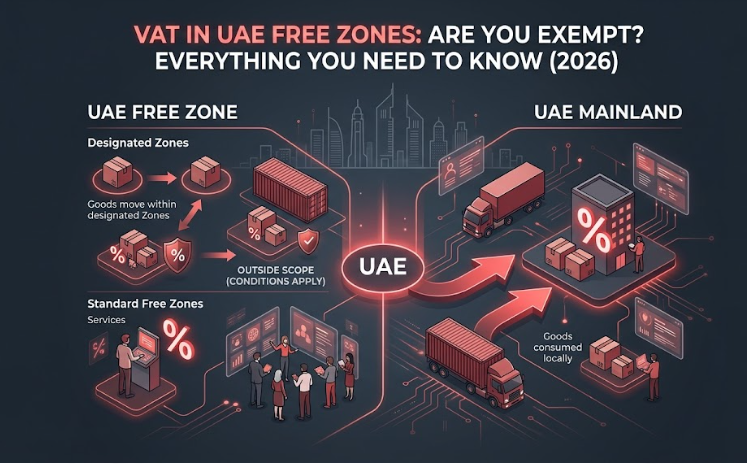
Businesses operating in UAE free zones often assume they are automatically exempt from VAT. In reality, the rules governing VAT in UAE free zones operations are more nuanced. VAT treatment depends on whether the free zone is classified as a designated zone, the type of transaction involved, and whether goods or services are supplied to UAE mainland.
This article explains how VAT in free zone UAE applies to businesses, when VAT exemption for UAE free zones may apply, and what UAE VAT freezone companies must consider to remain compliant. It also outlines registration requirements and common compliance risks affecting VAT for freezone companies in UAE.
Understanding VAT in UAE Free Zones
What Is a VAT Free Zone?
A VAT free zone in the UAE refers to a free zone that has been designated by the government for special VAT treatment. These areas are referred to as designated zones under UAE VAT legislation.
Designated zones are treated as being outside the UAE for VAT purposes only in relation to goods, provided certain conditions are met.
However, this treatment does not apply automatically to all activities carried out in a VAT free zone, and companies must assess their transactions carefully.
Designated Zones and VAT Treatment
The UAE government has listed specific zones that qualify as designated zones for VAT purposes. When goods move within or between these zones under qualifying conditions, they may be treated as outside the scope of VAT.
For businesses managing VAT in free zone UAE, this means the movement of goods within designated zones may not trigger VAT if regulatory requirements are satisfied.
However, once goods enter UAE mainland, normal VAT rules apply.
VAT Exemption for UAE Free Zones
When Does VAT Exemption Apply?
The concept of VAT exemption for UAE free zones applies primarily to certain goods transactions within designated zones.
For example, VAT treatment may differ when:
- Goods remain within a designated VAT free zone
- Goods move between designated zones
- Goods are stored in warehouses within designated areas
In these cases, the supply may fall outside the scope of VAT if all regulatory conditions are satisfied.
When VAT Still Applies
Despite the existence of VAT exemption for UAE free zones, VAT may still apply in several situations.
These include:
- Supplies of goods to UAE mainland
- Services provided by free zone businesses
- Goods leaving the designated zone for local consumption
For many UAE VAT freezone companies, these transactions are common, which means VAT compliance remains an important requirement.
VAT Registration for UAE VAT Freezone Companies
VAT Registration Threshold
The VAT registration threshold applies equally to mainland and free zone businesses. Companies must register for VAT if their taxable supplies exceed AED 375,000 per year.
This rule applies to UAE VAT freezone companies regardless of whether they operate in a designated zone or a standard free zone.
Voluntary registration may also apply when revenue exceeds AED 187,500.
Key Compliance Considerations
When managing VAT for freezone companies in UAE, businesses should consider several compliance factors:
- Whether the free zone qualifies as a designated zone
- The nature of goods or services supplied
- Whether transactions involve mainland UAE
- VAT documentation and record-keeping requirements
Understanding these elements helps ensure that VAT in free zone UAE obligations are properly managed.
Common Misconceptions About VAT Free Zones
Many businesses misunderstand how VAT free zone rules operate. One of the most common assumptions is that all activities carried out in free zones are VAT-exempt.
In practice, this is not the case. VAT for freezone companies in UAE depends on the nature of the transaction rather than the physical location of the company.
For example:
- Services supplied by free zone companies are generally taxable.
- Goods supplied to mainland UAE are subject to VAT.
- Companies exceeding the VAT threshold must still register.
For UAE VAT freezone companies, misunderstanding these rules can result in reporting errors, penalties, and regulatory issues.
Conclusion
Understanding VAT in free zone UAE rules is essential for businesses operating in the country’s free zones. While certain goods transactions within a VAT free zone may qualify for special treatment, this does not mean that all activities are VAT-exempt.
For many UAE VAT freezone companies, VAT obligations depend on how goods and services are supplied and whether transactions involve mainland UAE. Businesses must also understand when VAT exemption for UAE free zones applies and when standard VAT rules apply.
By properly managing VAT for freezone companies in UAE, businesses can avoid compliance risks and maintain accurate VAT reporting.
How We Helps
We supports UAE VAT freezone companies in understanding and managing VAT in free zone UAE requirements. Our team assists with VAT registration, exemption assessment, and ongoing VAT compliance.
By helping businesses determine eligibility for VAT exemption for UAE free zones and ensuring accurate reporting, We helps companies avoid penalties and maintain regulatory compliance.
Contact us today to simplify VAT for freezone companies in UAE and ensure your free zone operations remain fully compliant.

